
Service Plan Brief for Adult Day Health Care Services
Proposed Nursing Service Idea
The Adult Day Health Care Services Plan is a proposed nursing service idea involving alternative care for grown-ups over 60 who need medical management of a chronic illness or physical disability. Its fundamental essence is to postpone and prevent institutionalization while keeping individuals in their homes and communities for as long as possible.
The purpose of the nursing service line is to provide assistance and support to adults who need extra care if their primary caregiver still works or needs respite. For example, these may be patients suffering from the effects of stroke, COPD, or amputations due to diabetes. According to a diverse staffing model, the plan’s successful implementation involves leadership skills and approaches based on competent supervision and conflict management, effective communication, operating creative and innovative strategies, a manifestation of empathy and reflection, and using impartiality and objectivity in interacting with representatives of different cultures, nations, faiths, and more.
Importance
The importance and relevance of the services to the population are primarily to help and support elders who need supervision during the day. Adults have to go to work to provide for their families financially and deal with many household issues. They do not always have enough time to care for elderly relatives and communicate with them fully. Therefore, the services can enable caregivers to handle their day-to-day responsibilities best and continue their work activities (Gaugler et al., 2021). Faced with the situation of an older person losing self-service skills, relatives are still looking for a way out on their own. If, at the exact time, none of the family members have the opportunity to be near an elderly relative all the time, the problem is solved through specific services.
Market Analysis
SWOT Analysis
Strengths
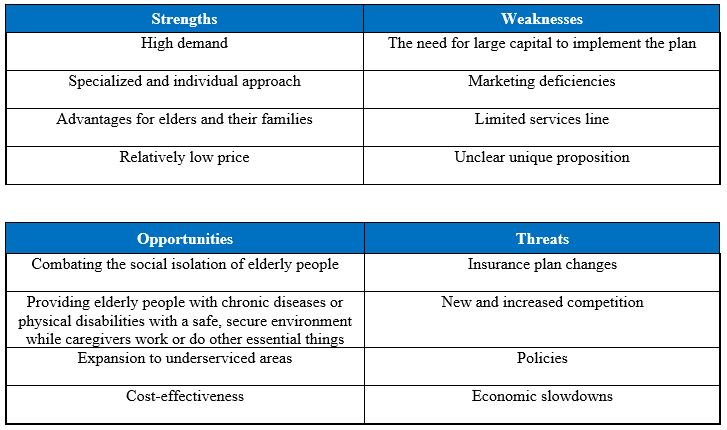
The following important points should be noted based on the Adult Day Health Care Services Plan’s SWOT analysis. SWOT analysis is a method of strategic planning to assess internal and external factors that affect the development of the organization and services (Good, 2020). Firstly, the plan’s idea mainly aims to benefit clients and their family members within the framework of providing quality temporary care for seniors and enabling their caregivers to take a break (Gaugler & Dykes, 2019). In general, the Adult Day daycare industry in the US is still developing continuously, and its services are in high demand, inexpensive, and available to most citizens of the country (Gaugler et al., 2021). Such services involve an individual approach to each client, following each individual’s characteristics and needs.
Weaknesses
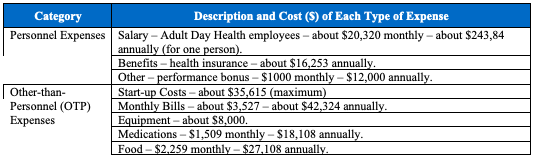
Secondly, the Adult Day Health Care Services Plan has significant weaknesses, such as the need for large capital to implement the plan, marketing deficiencies, limited service lines, and an unclear and unique proposition. For example, the amount needed to implement all the goals and objectives of the project is about $35,615. For the first time, costs will be required not only for the execution of the idea but also for promoting adult day services through well-configured targeted advertising. One must admit that the concept of adult day health care services is not new, and additional resources and time are needed to develop a better and more advanced proposition. Furthermore, the line of services is limited and is focused solely on caring for adults 60 and older.
Opportunities
Thirdly, providing daycare could be not only efficient and cost-effective but also good for society. Thus, the services will help combat the social isolation of the elderly, who fear becoming victims of crime and are forced to stay in their homes for a long time. In the future, they can be available almost anywhere in the country. This moment will enable many caregivers to take a break from caring for an elderly relative and not worry about their condition because their loved ones will be in a safe and comfortable environment.
Threats
Fourthly, with considerable probability, the Adult Day Health Care Services Plan may face external threats like insurance plan changes, new and increased competition, policies, and economic slowdowns. For example, some adjustments in existing laws and the basic principles of insurance programs like Medicare or Medicaid could entail significant changes in the plan’s structure and its implementation in practice.
In addition, one should remember the strength of the recession process and the reduction in economic activity, which affects the demand for services. Hence, financial instability in the country becomes a risk to the effective functioning of daycare services. Finally, one of the most apparent threats to the plan is competition from the outside.
Summary
In general, it is possible to maximize opportunity and capacity by improving, modernizing, and extending the plan’s benefits in the context of usefulness, accessibility, and exceptional service quality. Emphasis should be placed on meeting the population’s social and healthcare needs at an affordable cost to engage a larger audience, spread services, and combat isolation. Advantages and strengths can be leveraged to eradicate weaknesses by outlining a marketing strategy and a clear position in the sphere, attracting the attention of investors to services, and expanding the range of services provided.
Improvement and correction of weaknesses are possible through opportunities that give a chance to implement a cost-effective and efficient project, which should be invested in, developed, and promoted. The expansion of the line of services is mainly associated with its development. Consequently, minimizing risks and threats requires competent risk management by creating a unique offer at an optimal price. The plan’s structure should be detailed, and strategies should be thought through ahead of time to avoid external threats.
Cost-Benefit Analysis
Risk Assessment and Strategies
Financial Projections
Methods for Generating Revenue
Generating revenue for the nursing service line will be based on methods such as emphasis on low prices and increasing the number of customers through promotions and advertising. With The annual Rankings, you can gain data on community health factors and understand the landscape to make essential decisions about bringing people together to help and influence health (“County health rankings and roadmaps,” n.d.). Moreover, fees are relatively low compared to the quality and quantity of services provided, and this is the best option for many residents (Duncan et al., 2019).
To cover all costs and ensure profit, for the sake of any normal service functions, one can use a well-calculated markup. Efforts should especially be directed toward promoting the project through advertising since it is new and needs to be supported through promotion strategies. The estimated annual income is $438,000 based on a per-person cost of $100; the total daily revenue should be at least $1200.
Revenue Graph for Year 1
Service Payers
The financial payers for the Adult Day Health Care nursing service line are health plan providers, Medicare, and Medicaid. In this case, senior citizens can receive care in a facility and count on its partial coverage, including through various benefits. It is assumed that the project’s activities will be closely connected with the help and support of the state. This category additionally includes payers, insurers, and providers, but individuals are the primary purchasers of the services.
Operational Expense Budget
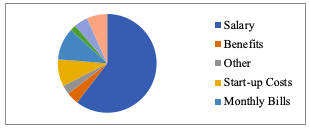
Budget Pie Chart
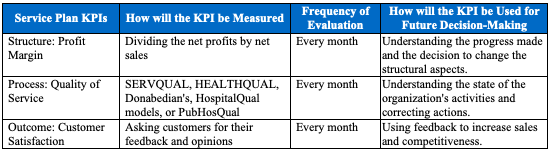
Key Performance Indicators (KPIs)
System-level Improvement
“Process: Quality of Service” is a system-level strategy to improve personnel and maintain teamwork. This KPI is one of the best ways to evaluate the quality and productivity of employees. It allows one to understand whether administrative staff needs monetary incentives and how convenient the bonus system is based on clear and transparent indicators. By comprehending the principles and concepts of the strategy in practice, it is possible to improve team spirit, cooperation, and collaboration.
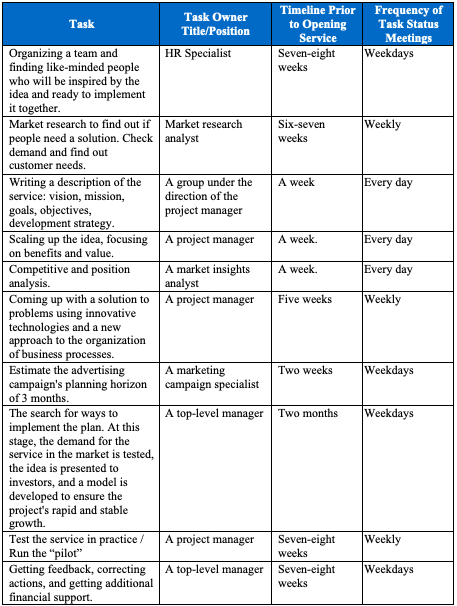
Tasks and Timelines
Executive Summary
Proposed Nursing Service Idea
It is no secret that the world’s population is rapidly aging, and the number of older adults is growing. Suppose in olden times, all generations lived in a big house under one roof, and the elderly and infirm family members received enough care and attention. The rhythm of modern civilization dictates different conditions, and children prefer to live separately; they are busy at work or in business and, unfortunately, cannot always give sufficient attention to their senior relatives. Consequently, the problem of caring for older people is acute in modern society.
In this case, the proposed nursing service idea is the Adult Day Health Care Services Plan aimed at supporting the elderly population of the United States. The service provides care for adults over 60 with chronic disease or physical handicaps. This project seeks to help older adults, their families, and caregivers. Due to the Adult Day Health Care Services Plan, older people can be in a safe environment during the day and receive a high service level. At the same time, caregivers can take a break and attend to work and other essential activities.
Market Analysis
The project’s target audience is men and women over 60 with physical health problems, an underserved group with limited access to resources. In addition, potential referral bases are clients and their relatives, various medical agencies, and organizations. Competitors in the area can be institutions providing social, therapeutic, nursing, and other services. The concept of giving daycare services is not new; however, the market is promising but not so competitive today.
SWOT Analysis
According to the SWOT analysis, the high demand for services at a reasonable price, individual approach to each client, and benefits for citizens mentioned earlier stand out particularly clearly as strengths. However, the plan has weaknesses regarding the need for capital to implement the project, the lack of development of a marketing plan and market position, and a limited line of services aimed exclusively at helping older people. It has the potential to expand and recoup costs and combat social problems by providing a comfortable and safe environment for older adults. External threats include changes in politics, economics, and customer demand due to high competition.
Cost-Benefit Analysis
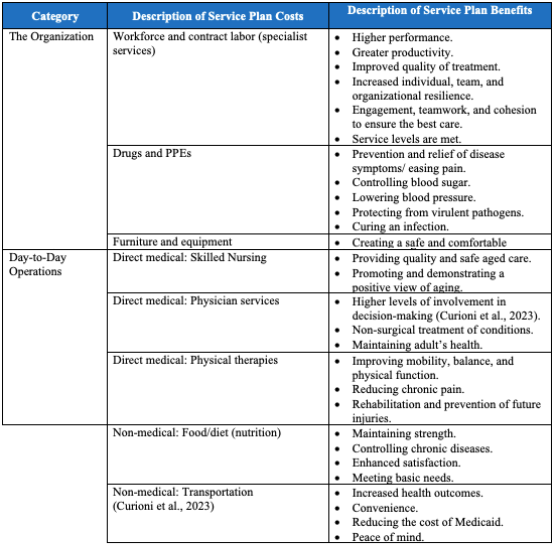
The cost-benefit analysis demonstrated that at the organizational level, there is a need to focus on the costs of labor, medicine, infection control, and special equipment and furniture. Accordingly, day-to-day operations include costs for nurses and physicians, physical therapy, client transportation, and meals. It is necessary to pay special attention to the aspects mentioned above to maintain the effectiveness of the organization and the services provided and to receive positive feedback on the quality of daycare.
Risk Assessment
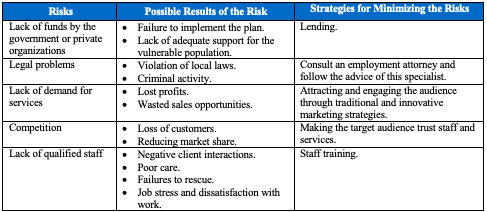
There are risks in the areas of finances, the legality of the service organization, competition, highly qualified employees, and probable lack of demand for services. Due to these risks, there is a possibility of an unfavorable outcome in the area of rule violations, reduced sales and customer demand, and poor service. To solve the problem with financing, you can ask for help from the state and various organizations or independently take a loan from a bank. Problems with the law can be avoided if one clearly follows the rules for doing business, and one should consult a lawyer beforehand.
High demand for goods is often achieved through clear marketing strategies and an emphasis on the uniqueness and importance of the services. Accordingly, it is possible to fight the competition through good quality service and attention to clients because quality service is no less important than price. Moreover, there are times when specialists are not sufficiently trained in their field, and it is possible to eradicate this problem through continuous training and development.
References
County health rankings and roadmaps. (n.d.). Missouri: St Charles County.
Curioni, C., Silva, A. C., Damião, J., Castro, A., Huang, M., Barroso, T., Araujo, D. & Guerra, R. (2023). The cost-effectiveness of homecare services for adults and older adults: A systematic review. International journal of environmental research and public health, 20(4), 3373. Web.
Duncan, L., Bowla, J., & Tanis, R. (2019). Evaluating the effectiveness of adult day care on alleviating caregiver stress/burden. Florida public health review, 13(2), 1-23. Web.
Gaugler, J. E., & Dykes, K. (2019). Assessing mechanisms of benefit in adult day programs: The adult day services process and use measures. Aging & mental health, 23(9), 1180-1191. Web.
Gaugler, J. E., Marx, K., Dabelko-Schoeny, H., Parker, L., Anderson, K. A., Albers, E., &Gitlin, L. N. (2021). COVID-19 and the need for adult day services. Journal of the American medical directors association, 22(7), 1333-1337. Web.
Good, C. (2020). Plot your next move with a SWOT analysis. MGMA Connection.
Sadarangani, T., Missaelides, L., Eilertsen, E., Jaganathan, H., & Wu, B. (2019). A mixed-methods evaluation of a nurse-led community-based health home for ethnically diverse older adults with multimorbidity in the adult day health setting. Policy, politics, & nursing practice, 20(3), 131-144. Web.
