
Problem Background
The business world today is becoming increasingly complex, making it harder for organizations to manage the increasingly intricate relationships between different stakeholders. The truth demonstrates that businesses should emphasize cost and productivity more to prosper and develop sustainable and effective organizations. The ability of the businesses to handle the human component and build on motivation and retention, which will foster loyalty and motivate performance, is the source of this productivity. In light of this, human resource management (HRM) offers essential services to every business, including those in the healthcare industry.
It is no secret that the evolution of HRM activities over the past few decades was primarily driven by the changing nature of the business environment and increasingly complex organizational structures. Regarding organizational development, the HRM department today plays a strategic role instead of a supportive one as it did twenty years ago. Numerous factors entered the everyday work of HRM experts due to the change from a short-term to a long-term position in the organization. Recruitment and selection, compensation and benefits, training and development, and other crucial organizational elements are now included in HRM functions. Although the HR department does not directly create income, its contribution to operational effectiveness and adherence to the law is crucial for its success and lucrative operations.
In the years since COVID-19, hospitals and the larger healthcare sector have seen significant upheaval and transition. Nevertheless, in essence, patients’ and clients’ expectations for healthcare are always emotional. Since the healthcare sector is the only one in the world to deal with life and death, providing effective, high-quality care requires more than just clinical expertise and technical know-how. In high-touch healthcare settings, where interpersonal relationships, teamwork, and personal touch are crucial, healthcare personnel must have specific soft skills to be more successful team members and help patients achieve their health goals in a comfortable healing environment.
With this research, I aim to analyze the administration and professional growth of hospital personnel. The healthcare sector needs employees who develop strong leadership skills as it continues to change. Employees who can motivate those around them to achieve greatness and provide patients with high-quality treatment are essential to an organization’s success. Therefore, the objectives of the projects are exploring the best HRM strategies in hospitals that result in practical work of healthcare professionals and discovering HRM activities that might increase the health system’s effectiveness. Based on the aim and objectives of the project, the following research questions were identified:
- How could HRM functions be applied to hospital staff management and development?
- Could HRM activities and systems from other industries be applied in the healthcare system?
- What are different HRM strategies that can be applied to hospitals?
Literature Review
The level of investment made by firms in finding, selecting, managing, and retaining the finest people capital is typically referred to as HRM (Oppel et al., 2019). The relationship between HRM and performance has been studied over the past 20 years from a range of theoretical angles, including institutional theory, human capital theory, contingency theory, and resource-based theory (Al-Ayed, 2019). These theories have shed important light on several ways in which HRM functions. The firm’s resource-based view (RBV), which has emerged as the preeminent theoretical paradigm in strategic HRM research, has been particularly used by scholars (Paauwe & Boon, 2018). They used it to understand the circumstances in which human resources can serve as a source of sustained competitive advantage.
Health systems are complicated and constantly evolving across various contexts and levels of health care. The capabilities required of health managers and leaders to respond to present and developing crises are still poorly recognized. Therefore, Figueroa et al. (2019) examine current and emerging challenges for health leadership and workforce management in various contexts and health systems at three structural levels, beginning with the overarching context, progressing to the context of organizations, and ending with the micro context of individual healthcare managers.
The organization can adopt value-creating strategies that are challenging for rivals to imitate thanks, in part, to the combination of a high-quality human capital pool and effective HR methods for managing people from a resource-based perspective (Schneider et al., 2021). While it is true that rivals can easily copy individual HR strategies, it is asserted that the interconnectedness of various HR practices within an HR system can both have synergistic effects and serve as a deterrent to copying.
By empowering and inspiring employees to act in ways that are compatible with the organization’s goals, an HR system can improve the performance of the business. As a result, HRM influences performance outcomes through crucial mediating variables such as employees’ attitudes and behaviors (Schneider et al., 2021). Although research on HRM at the macro level using the RBV has substantially added to our understanding of the relationship between HRM and performance, recent researchers have shown that this causal chain is more complex than previously believed (Paauwe & Boon, 2018). Research has, therefore, increasingly embraced a micro-level viewpoint that emphasizes employees’ views of and reactions to HR practices to understand better the mechanisms by which a firm’s HR system affects performance.
According to the theories mentioned above, employees’ perceptions of HR systems are believed to impact attitudinal and behavioral HR results, which in turn affect performance outcomes (Gile et al., 2018). Through HR practices and employees, employees are sent messages about the objectives of their employers. Because employees interpret HR practices differently, this causes variations in how they react. For instance, it is asserted that different HR system configurations, i.e., whether an HR system is commitment-oriented (HR practices linking employee and organizational goals) or control-oriented (HR practices emphasizing reducing labor costs and improving efficiency), lead to different employee attributions and behaviors.
Providing employment resources has a favorable influence on the ability, motivation, and opportunity to continue working. Furthermore, workability was shown to be most adversely connected to job demands, whereas employability was most positively related to developmental practices (Pak et al., 2019). Therefore, the research consolidates information on the measures that organizations may take to assist in extending working lives by determining and analyzing the efficacy of Human Resource Management initiatives aimed at extending working lives.
According to empirical research from the banking and service industries, employee perceptions of HR systems are correlated with workplace behaviors, including organizational citizenship behaviors and employee service performance (Johansen & Sowa, 2019). According to Oppel et al. (2019), sophisticated HR systems in hospitals increase the likelihood that staff members will be willing and able to engage in behaviors that result in the delivery of high-quality healthcare. For example, knowledge sharing accounts for the positive correlation between HR practices and patient mortality.
The provided literature is directly connected to the HR systems in the healthcare system. As the project aims to examine hospital staff management and development, the research fits into the literature available on the topic. Moreover, considering that the research objectives and questions mainly consider discovering and exploring the best HRM strategies in the healthcare system, the project provides an overview of current knowledge based on the literature. In addition, the project allows the identification of relevant methods and gaps in the existing research that can be later implemented in the paper.
Research Process
This research will be conducted in the context of NHS-run public hospitals in England. As the NHS is the world’s largest publicly funded healthcare system, it can be considered the most reliable source of information for research. The NHS National Staff Survey will be examined to understand the relationship between hospital staff management and performance. If there is an access issue, I will create a survey for hospital staff and ask local hospitals to take the survey.
Moreover, I plan to do face-to-face interviews with some respondents to deeply analyze healthcare professionals’ attitudes toward HRM practices. I plan to gather an overall of 100 respondents from the survey and take five in-depth interviews among them. It allows me to get valuable and detailed answers to further work with. Using the qualitative method, the research attempts to reveal the experiences of healthcare workers under different HRM strategies and identify the best strategy. In this project, I intend to choose a pragmatic approach to research philosophy as the work focuses more on practical solutions and results. This can help future studies to research more on some aspects of HRM, including the advantages and disadvantages of each strategy.
In qualitative research, information that is not statistically recorded, such as text, audio, or video, is gathered and then examined. The information is used to comprehend intricate ideas, events, and viewpoints. Qualitative research offers novel research concepts as well as prospective insights into the research issues. Thus, qualitative research aims to get as much information out of a small size as feasible. It is a more flexible strategy than quantitative research since it lets participants express themselves while providing personal data.
Research Plan and Timeline
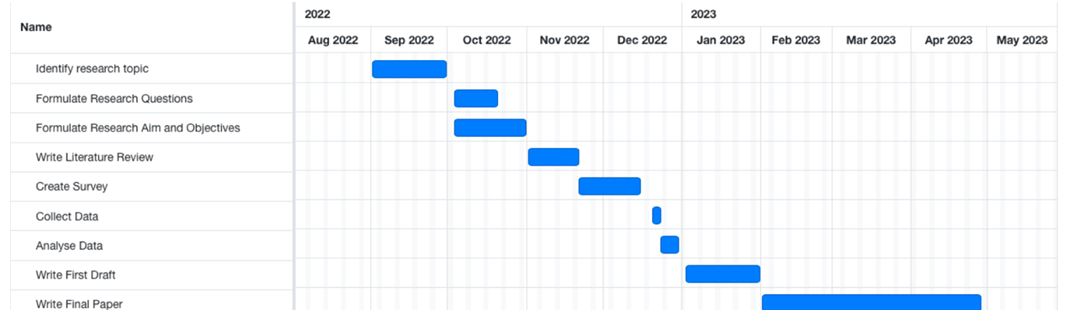
I will first do a theoretical background, searching for the relevant literature. This will be until November 20. Following that, I will create questions for surveys and consent forms for hospitals. Beginning in December, I will conduct my surveys, and after getting responses, I will choose five people to interview. The interviews will be scheduled during 20-23 December.
After the interviews, I will collect the results between the 25 and the 30 of December. Starting in January, I will begin writing the first draft. After a month, I plan to consult with the supervisor on the final draft, and after that, I will start writing the final version of the paper. The estimated due dates for each step of the final project can be seen in the Gantt chart below (Figure 1).
Reference List
Al-Ayed, S. I. (2019). ‘The impact of strategic human resource management on organizational resilience: an empirical study on hospitals’, Verslas: Teorija Ir Praktika/Business: Theory and Practice, 20, pp. 179-186.
Figueroa, C. A., Harrison, R., Chauhan, A. and Meyer, L. (2019). ‘Priorities and challenges for health leadership and workforce management globally: A rapid review’, BMC Health Services Research, 19. Web.
Johansen, M. S. and Sowa, J. E. (2019). ‘Human resource management, employee engagement, and nonprofit hospital performance’, Nonprofit Management and Leadership, 29(4), pp. 549-567.
Gile, P. P., Buljac-Samardzic, M. and Klundert, J. V. D. (2018). ‘The effect of human resource management on performance in hospitals in Sub-Saharan Africa: a systematic literature review’, Human resources for health, 16(1), pp. 1-21.
Oppel, E. M., Winter, V. and Schreyögg, J. (2019). ‘Examining the relationship between strategic HRM and hospital employees’ work attitudes: an analysis across occupational groups in public and private hospitals, The International Journal of Human Resource Management, 30(5), pp. 794-814.
Pak, K., Kooij, D. T. A. M., De Lange, A. H. and Van Veldhoven, M. J. P. M. (2019). ‘Human resource management and the ability, motivation and opportunity to continue working: A review of quantitative studies’, Human Resource Management Review, 29(3), pp. 336-352.
Paauwe, J. and Boon, C. (2018). ‘Strategic HRM: A critical review’, Human resource management, pp. 49-73.
Schneider, A. M., Oppel, E. M. and Winter, V. (2021). ‘Explaining variations in hospitals’ use of strategic human resource management: How environmental and organizational factors matter’, Health Care Management Review, 46(1), pp. 2-11.
