
Company Background
Apple, Inc. designs, manufactures, and sells cellphones, notebooks, wearables, and peripherals and provides a range of connected services. The company engages in Europe, Japan, Greater China, the Americas, and the rest of Asia-Pacific (Apple, 2022). North and South America are included within the Americas segment. The Europe category includes European nations and those in the Middle East, India, and Africa. Greater China includes mainland Hong Kong, China, and Taiwan. Australia and Asian countries comprise the rest of the Asia-Pacific section.
Mac, iCloud, iPhone, Apple Watch, Beats devices, digital entertainment shops, subscription, and broadcasting solutions are among its goods and services (Apple, 2022). The corporation was established on April 1, 1976, by Steven Paul Jobs, Ronald Gerald Wayne, and Stephen G. Wozniak and is situated in Cupertino, California.
Analysis of Operation Management Challenges
Seven Wastes of Lean Management
Eliminating wasted operations is one of the necessary conditions for creating a profitable business. This principle is fundamental to Lean philosophy and contributes to the competitiveness of enterprises (Kumar, 2022). Apple Inc. must therefore pinpoint the non-value-adding activities and either attempt to enhance the operation where they occur or terminate them. The following seven wastes of lean management highlight some of Apple Inc.’s OM challenges.
Inventory Wastes
Since Apple Company functions globally, it occasionally faces issues with product supply resulting from inadequate inventory management. Bullwhip and order batching issues develop when Apple Company workers or contractors indulge in improper inventory management procedures. The behaviors result in higher expenses for activities such as shipping and storage.
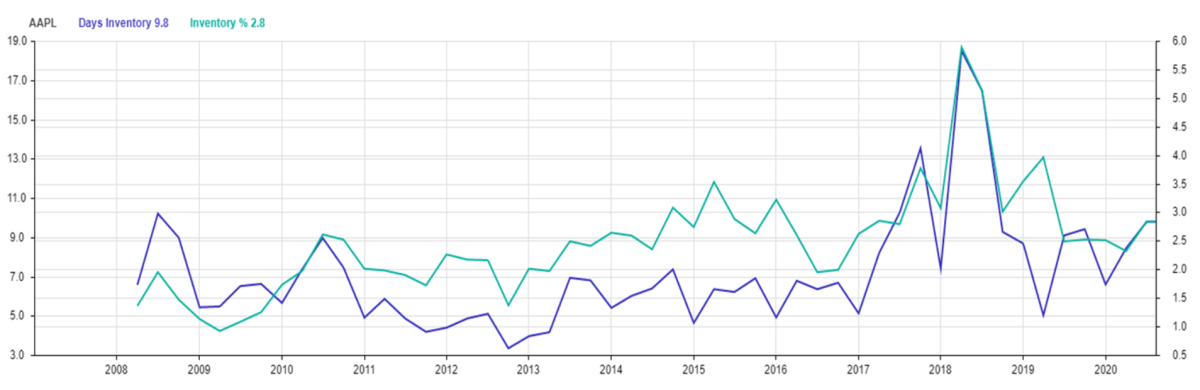
Despite everything that has occurred thus far in 2019, the chart below demonstrates that Apple’s key inventory measurements have stayed relatively constant since the beginning of the year. However, the preceding years have seen Apple struggle to maintain its stock levels to the desired by investors and shareholders. In the recent quarter of 2022, stock as a proportion of total assets decreased somewhat year-over-year to less than 3% (Martins, 2020). Figure 1 shows Apple’s stock management level from 2008 to 2020.
Overproduction
Manufacturing more means exceeding the client’s requirements, which incurs additional expenses. The iPhone 14 was a minor upgrade over the iPhone 13, although the iPhone 14 Pro gained more substantial changes. Apple’s new iPhone 14 range proved less popular than anticipated.
Wu & Mochizuki (2022) reported that the Cupertino-based technology business manufactured approximately 90 million devices in the second half of the previous year. While Apple initially requested that its production partners create 6 million different smartphones for the second period this year, it has since dialed back production to levels comparable to last year (Wu & Mochizuki, 2022). As a result, the company readjusted its manufacturing goals by reducing further orders for the item.
Extra Processing
Apple’s lean application development transforms additional production, an inefficiency of agile output, into relearning. Relearning is the continuous acquisition of knowledge via different routes (Olsen & Tomlin, 2020). Apple’s extensive documentation and user guides, which nobody reads, and its additional planning initiatives are examples. The time, effort, and money spent on creating documentation that might have been communicated verbally or via email are squandered. However, Apple provides these certified user guides in electronic files for free.
Transportation
This type of waste occurs when a company shifts resources without adding value to the product. Frequently, shipping may require Apple to incur extra expenses for effort, space, and equipment since freight costs have increased significantly. The cost of delivering a 40-foot container of products from Asia to the United States approached $10,000, an increase of 229% over last year (Kay, 2021). As several cargo containers queue to land at congested terminals and freight forwarders have difficulty finding enough operators to move items on the ground, the cost of transporting merchandise has grown more aggressive.
Waiting
When items or tasks are stationary, delayed waste arises, and it is detectable, as time wasted is the most apparent factor that companies can identify. During the COVID-19 pandemic, Apple’s shipments were delayed by significant COVID-19 inoculations, which impacted the availability of its delta edition, and unexpected issues with COVID-19 outbreaks led to a considerable market contraction in 2020 (Kay, 2021). During the company’s earnings report in 2020, Cook informed shareholders that supply limitations, including the global processor shortfall and silicon barriers, had further influence on iPhone and iPad production in the autumn (Kay, 2021).
Motion
This type of waste comprises complicated and needless personnel or equipment operations. They can result in damages, work stoppages, and more. Apple Inc. postponed a proposal to force employees to return to the office three days per week, citing an increase in COVID-19 instances as the greatest impediment in its attempts to get back to normalcy. Under the now-discontinued scheme, employees were compelled to be in the office on Mondays, Tuesdays, and Thursdays (Gurman, 2022). This affected the OM in manufacturing its products, including the iPhone, in nations such as China.
Defects
Defects can result in reworking or, even worse, scrapping, as typically, poor work must be returned to manufacturing, which wastes essential time. Some consumers complained that a severe flaw in Apple’s newest iPhone caused the lens to malfunction when using programs like Snapchat, TikTok, and Instagram. The drawback in the corporation’s most costly iPhone 14 variant, the iPhone 14 Pro Max, seemed to damage the optical image stabilization (OIS) technology, which employs a motor to prevent camera movement when taking photographs (Hern, 2022). Activating the camera in specific applications prompts the OIS motor to malfunction, resulting in loud, crunching tones and physical phone vibrations.
Supply Chain Analysis of iPhone Product
The key players in the iPhone supply chain are Foxconn and Pegatron assemblies in China, Sony manufacturers, and LG Company. Foxconn and Pegatron run the Chinese assembly plants in Guangdong, Henan, Shandong, and Shanghai. China’s manufacturing centers receive elements such as displays, lenses, motors, CPUs, RAM chips, and fingerprint scanners from these manufacturers (Sodhi & Tang, 2019). Motherboards, connecting transistors, and other vital procedures are assembled by robots, while humans combine RAM and do test automation, verification, and packaging.
Contract production vendors with numerous facilities in China, such as Foxconn and Pegatron, coordinate the delivery of materials from suppliers, organize the assembly lines according to the needed output, and commence assembly. When a product is introduced, the facility has a capacity of 500,000 units per day, as shown in Figure 2 (Sodhi & Tang, 2019). Products completed and packaged are shipped to regional offices and dealers in various nations. Sony, which makes cameras in Japan, and LG, which produces lenses in South Korea, obtain purchase requisitions detailing the volume and fulfillment timeframes.
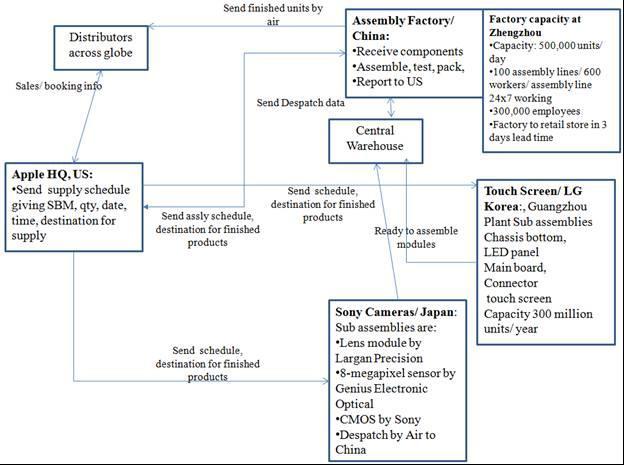
Across the distribution network illustrated in Figure 2, Apple Inc. controls the central warehouse, distributors across the globe, and the two assembly plants in China, Foxconn and Pegatron. Apple has focused primarily on product innovation and consistently produced unique items, releasing them on the marketplace before its rivals manufacture a comparable product. In addition to generating quality solutions, Apple may strengthen its production process by locating a portion of its logistics activities near the final consumers. This is not the situation for Apple’s iPhone, as its whole distribution network is located in Asia, where it is produced.
Moreover, Apple should explore unifying its iPhone supply chain by minimizing the number of its contracted vendors, gaining more clarity and the capacity to initiate incentives more effectively. Suppliers whose earnings are overly dependent on Apple’s acquisitions are likely to prefer Apple’s management and principles, further emphasizing why the leadership team must advocate and maintain their stated ideals.
Risk Analysis
Table 1: Apple’s Operation Management Risk Register
Improvement Recommendations
Apple could adopt real-time analytics to minimize inventory waste and monitor stock levels. With numerous types of technologies available to producers nowadays, it would be detrimental for a company not to utilize them. Real-time intelligence alludes to software and programs that analyze a firm’s real-time supply chain statistics, recording stock alterations as they occur (Jalil et al., 2019). This would be advantageous for Apple because it would improve accuracy. The real-time application would give a database of the many sorts of inventory Apple holds at any given time. Experts can then analyze this information to determine where profitable times fall within the economic cycle of a corporation.
Moreover, Apple should spend money on its research and development (R&D) activities to design its products better. An R&D department aims to maintain a company’s competitiveness by supplying market intelligence and producing new solutions and commodities or enhancing existing ones correspondingly (Waleczek et al., 2019). In avoiding a similar case like that of iPhone 14’s over-processing lenses, more expenditure on its R&D would ensure such mistakes never occur, thus improving its OM. Lastly, to avoid waiting for waste and delays in the market delivery of its products, Apple should increase the number of its suppliers to reduce vendor complexity within its logistics system.
References
‘Apple’ (2022). Forbes. Web.
DuHadway, S., Carnovale, S., & Kannan, V. R. (2018). Organizational communication and individual behavior: Implications for supply chain risk management. Journal of Supply Chain Management, 54(4), 3-19. Web.
Elsharydah, A., Michaelis, M. A., & Rajan, N. (2020). Lean management: Inventory, waste management. In: Rajan, N. (eds) Manual of practice management for ambulatory surgery centers (pp. 113-118). Springer.
Gurman, M. (2022). Apple delays plan to have staff in office three days a week. Bloomberg. Web.
Hern, A. (2022). Bug in iPhone 14 Pro Max causes camera to physically fail, users say. The Guardian. Web.
Iqbal, B. A., Rahman, N., & Elimimian, J. (2019). The future of global trade in the presence of the Sino-US trade war. Economic and Political Studies, 7(2), 217-231. Web.
Jalil, N. A., Prapinit, P., Melan, M., & Mustaffa, A. B. (2019). Adoption of business intelligence-technological, individual and supply chain efficiency. In 2019 International Conference on Machine Learning, Big Data and Business Intelligence (pp. 67-73). IEEE.
Kay, G. (2021). Tim Cook says Apple is “paying more for freight” than he’d like, as experts predict shipping costs for businesses have yet to hit their peak. Business Insider Africa. Web.
Kumar, R. (2022). Operations management. Jyothis Publishers.
Martins, D. (2020). Apple: Kings of inventory management. Apple Maven. Web.
Olsen, T. L., & Tomlin, B. (2020). Industry 4.0: Opportunities and challenges for operations management. Manufacturing & Service Operations Management, 22(1), 113-122. Web.
Sodhi, M. S., & Tang, C. S. (2019). Research opportunities in supply chain transparency. Production and Operations Management, 28(12), 2946-2959. Web.
Waleczek, P., von den Driesch, T., Flatten, T. C., & Brettel, M. (2019). On the dynamic bundles behind operations management and research and development. European Management Journal, 37(2), 175-187. Web.
Wu, D., & Mochizuki, T. (2022). Apple ditches iPhone production increase after demand falters. Bloomberg. Web.
Xu, W., Tao, C., Yujie, W., Qinrui, G., & Yangxin, T. (2018). Risk assessment of power information risk security based on risk matrix. In 2018 IEEE 3rd Advanced Information Technology, Electronic and Automation Control Conference (pp. 1494-1498). IEEE.
Yun, B. S., Lee, S. G., & Aoshima, Y. (2019). An analysis of the trilemma phenomenon for Apple iPhone and Samsung Galaxy. Service Business, 13(4), 779-812. Web.
Appendix 1
The rating instrument utilized for measuring the risk’s severity and probability of the risk.
Appendix 2
The risk assessment proportion (Likelihood by impact) (Xu, et al., 2018).
